0
- Ski Chalets
- Villas
- Destinations
- Collections
 Search
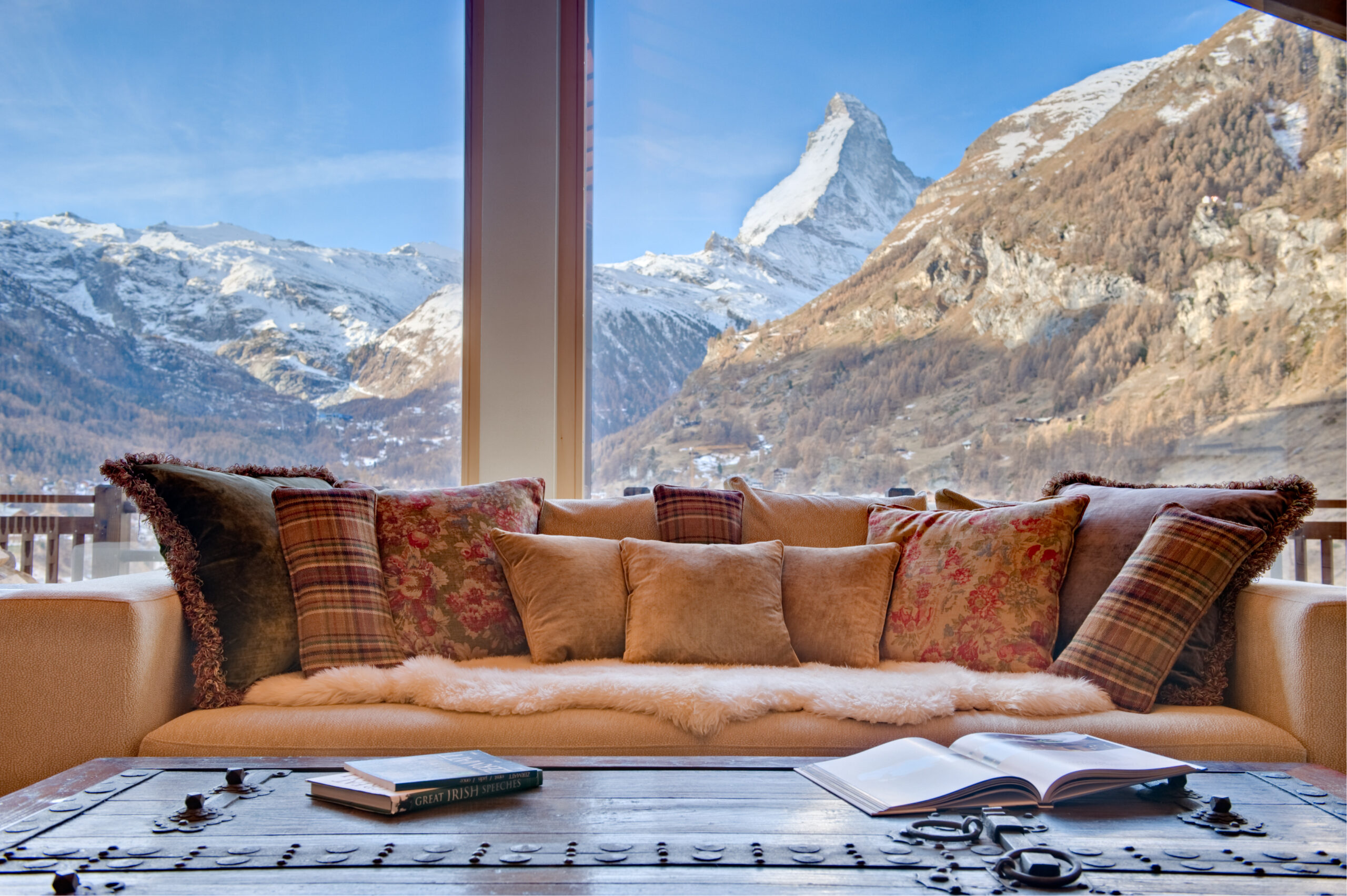
Once a traditional Swiss mountain village, Zermatt developed into one of the Alps’ most sophisticated ski destinations, combining a large high-altitude ski area with excellent restaurants and luxury accommodation to match. Zermatt is one of the most recognisable ski resorts in the Alps, but there is considerably more to skiing in Zermatt than just the postcard Matterhorn views.
The resort is also car-free, giving the village a distinctly different feel from many of the larger French and Austrian ski resorts. The skiing itself is equally distinctive. The Matterhorn Ski Paradise links Zermatt with Cervinia in Italy, creating around 360km of pistes across two countries.
For experienced skiers, this means there is enough to explore for over a week without constantly repeating the same runs. For families and less experienced skiers, there are dedicated learning areas and gentler pistes, particularly around Sunnegga.
And for non-skiers, Zermatt works particularly well, with cute mountain railways and cable cars making it possible to meet those on skis or visit high-altitude viewpoints, restaurants and attractions super easily.
In this guide, we look at skiing in Zermatt, from the different sectors of the mountain and the best terrain for different abilities to the realities of getting around a car-free resort, choosing a chalet and making the most of the Italian side of the ski area.
Browse our collection of luxury ski chalets in Zermatt, or speak to our ski specialists (+44 203 432 7784) about the best areas and properties for your group.
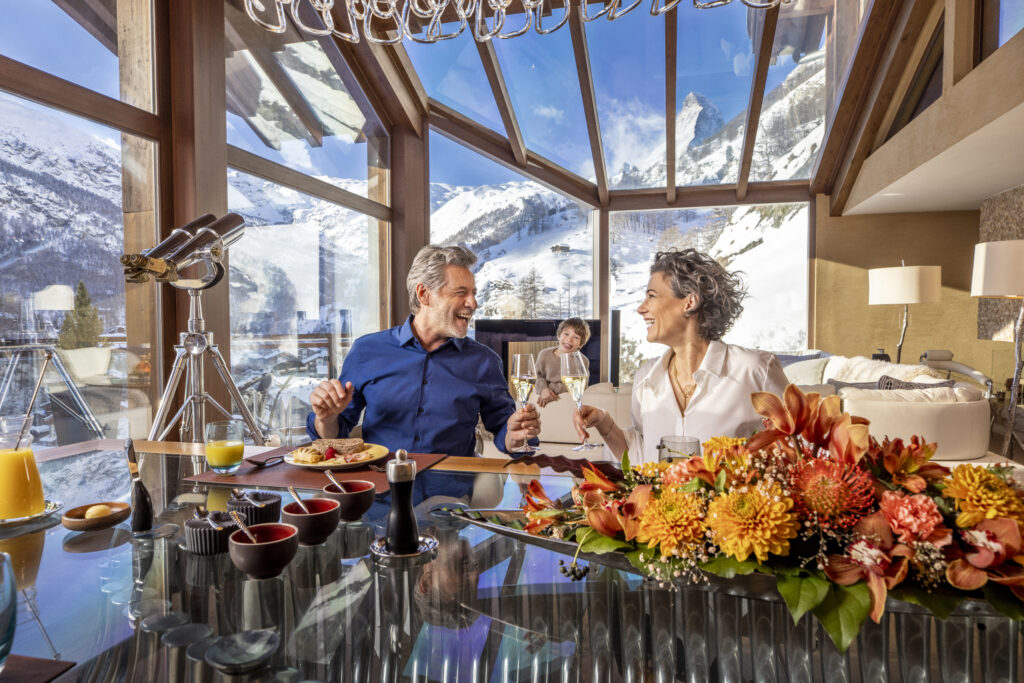
Zermatt’s appeal comes partly from the sheer altitude of the skiing, but also from the way the resort combines mountain infrastructure with a proper, authentic village
The village itself sits at around 1,620m, and the ski area rises to 3,889m at the top of the Matterhorn Glacier Express. This is the highest lift-accessed skiing in Europe.
The Swiss, Zermatt side of the ski area is divided broadly into three main sectors: Sunnegga-Rothorn, Gornergrat and Matterhorn Glacier Express. These are all interconnected through the lift network and mountain railways, but each has a noticeably different character and, typically, you want to choose an area to focus on each day depending on what restaurants you want to visit, the abilities of the group and the weather. If you’re skiing in Zermatt with a private guide, they can, of course, do this bit for you!
There is also a practical difference between Zermatt and many of the major French resorts. Zermatt is car-free, and the mountain transport system is integrated into everyday life. Electric buses, taxis, trains, funiculars, gondolas and cable cars all play a role in moving people around.
This is one of the things that gives Zermatt its character, but it also means that chalet location deserves attention. A property described as central may be very convenient for restaurants and shops but isn’t likely going to be the most convenient for skiing. Equally, a chalet with excellent mountain access often sits further from the heart of the village.
Since the layout isn’t designed and developed around skiing in Zermatt, there’s an element of compromise on location or logistics for getting around. It’s well worth it for the cute, authentic village, though!
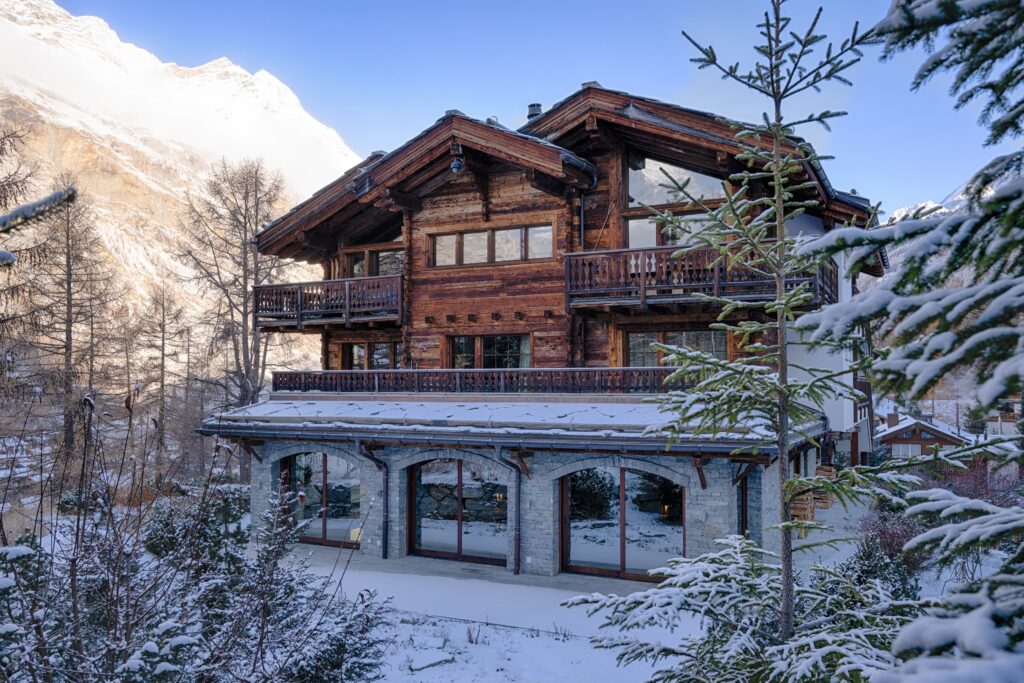
Strict planning and building regulations have limited large-scale development, meaning there are fewer new-build luxury chalets than you might find in some of the French resorts. The result is a relatively select market.
Nevertheless, our collection includes everything from intimate chalets for smaller groups to larger properties, with catered, self-catered and breakfast-only options. We know that choosing the right property requires a little more thought than simply finding a chalet with the best Matterhorn view.
Some of the larger chalets have private pools, hammams, saunas, cinemas and extensive entertaining space. One of the most special being Chalet Zermatt Peak. Others focus more on traditional Alpine design in their luxurious interiors and Matterhorn views, such as Chalet Les Anges and Grace.
If a particularly convenient location for skiing and town is a priority, then the Seven Heavens development (aptly named after the world’s highest peaks) includes Chalet Denali, Elbrus, McKinley and Aconcagua. These are right between the centre of Zermatt and the Sunnegga funicular and defeat the typical rule in Zermatt that you can’t have perfect access to both.
Although building restrictions are tight, there are some exciting new developments such as Chalet Kemaura or the Dufourspitz Lodge (which also has some sister properties too). There are also properties such as Backstage Loft and Backstage Chalet with hydraulic jacuzzis – one of which can be lifted from indoors to outdoors through the roof, or another where the walls move away for the same effect.
Catered chalets are particularly attractive for groups who want the convenience of having breakfast and dinner organised for them, but there’s a very good argument for self-catering in Zermatt. The village has an extensive restaurant scene, one to rival that of many cities.
For a group that wants to spend several evenings trying different restaurants, staying in self-catered apartments such as the Christiania Residence with Christiania Penthouse at its crown gives you a lot more flexibility.
For families or groups who prefer to come home after skiing and settle in for the evening, a fully catered chalet can, of course, be a better fit.
The important thing with Zermatt is to understand there’s going to be a bit of a journey between accommodation and skiing or town.
There are very few ski-in/ski-out chalets in Zermatt. The village sits at the bottom of some super steep-sided mountains; hence, the pistes home are steep drops into the village. Unlike resorts like Courchevel that are built around the skiing, Zermatt’s traditional layout means the town and luxury chalets aren’t around the pistes.
Since Zermatt is built at the bottom of quite steep sided mountains a lot of the newer development sprawls onto and up the craggy cliffsides since space is so limited. The result is that a number of luxury chalets and hotels have quite unique entrances through tunnels and elevators built into the rock.
This means they often have particularly good access to the lifts or town via their private tunnels and elevators, even if, Google Maps says otherwise. An example of this are sister properties Chalet Gemini, Castor, Pollux and Carmen.
Even if you don’t have a private tunnel and ski room that pops you out right by the lifts, communal ski lockers at the lift stations mean that you don’t necessarily need to carry your skis back and forth through the village every day, while electric taxis make it straightforward to get around.
Browse our collection of luxury chalets in Zermatt here.
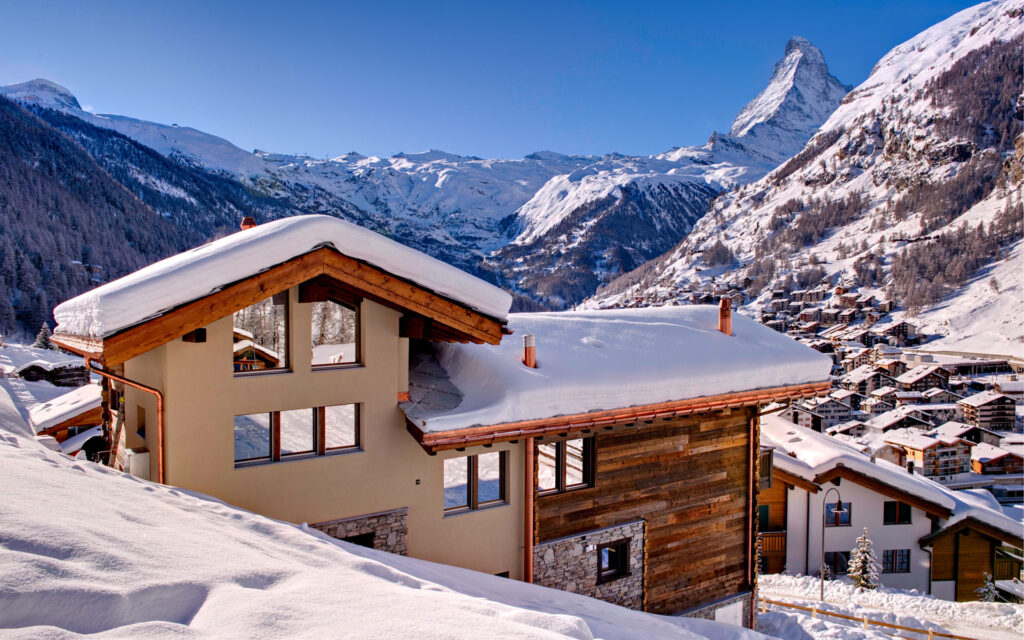
Zermatt is compact enough that most areas are accessible, but different locations suit different types of holidays.
Staying centrally is useful if restaurants, bars and shops are important.
It also makes the village particularly easy to explore on foot. The trade-off is that you may be further from the ski lifts. Particularly if you want to ski Cervinia accessed from the Matterhorn Glacier Express – this is on the other side of town.
Winkelmatten is a much quieter residential area towards the southern end of the village. It has a more peaceful atmosphere and really feels very authentic and cute. Like some proper locals still live here. You’ll even walk past their barns with farm animals in and equipment outside.
Being at the southernmost end of the village, you typically have uninterrupted views of the Matterhorn, so, this area can work particularly well for groups who want good views, lots of space and a more authentic stay.
This area is technically ski-in/ski-out for some properties, and a lot of places like to advertise this accordingly. This is via the Moos itinerary piste; however, it is subject to snow conditions and is best for advanced skiers.
Sunnegga is particularly useful for families and beginners because of the direct funicular connection from the village straight to the easier slopes in the area.
If you are travelling with children who are learning to ski, or with a group where some members are less confident, proximity to Sunnegga can be a useful consideration.
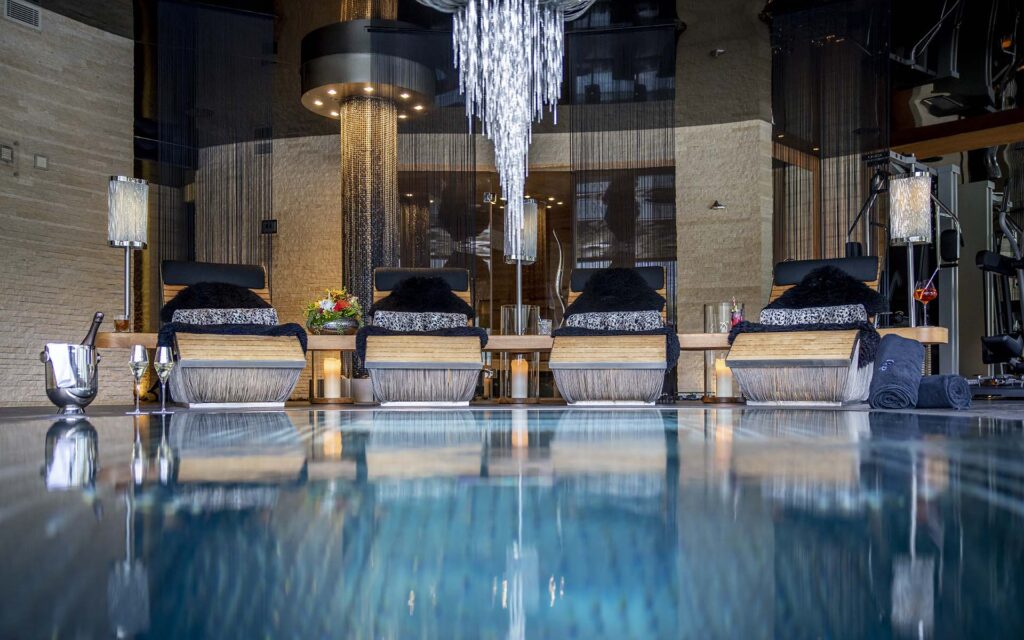
Zermatt works very well for families, particularly those who want a resort where there is plenty to do away from the slopes.
A group might include keen skiers, beginners and people who do not ski at all, and everyone can still have a full day in the mountains. Non-skiers can take mountain railways to high-altitude restaurants and viewpoints while the stronger skiers explore further around the ski area.
Zermatt is also a natural choice for adults who want a combination of skiing, food, nightlife and a high standard of accommodation. The village has enough restaurants and bars to make a week feel varied without being dominated by nightlife.
Zermatt is particularly well suited to confident intermediate skiers and above. There’s an extensive network of blue and red runs across the Swiss and Italian side, while the ability to explore different sectors makes it easy to build variety into a week’s skiing.
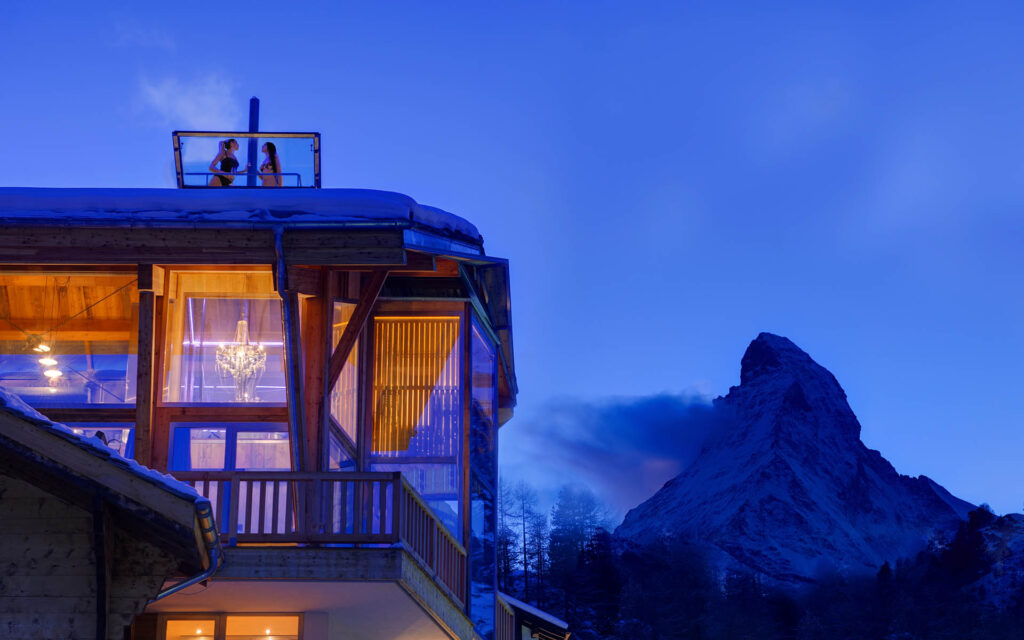
Zermatt has one of the longest ski seasons in the Alps, thanks largely its altitude and surrounding glaciers. The ideal time for you to visit depends on what you want from your holiday.
Christmas and New Year are among the busiest and most expensive periods in Zermatt. The village is particularly atmospheric at this time of year, and the Matterhorn provides an extraordinary backdrop, of course. For groups looking for a luxury chalet over Christmas or New Year, we recommend booking well in advance, particularly for larger properties.
January tends to offer classic winter conditions. It can be a good choice for experienced skiers who are primarily focused on skiing rather than spending long afternoons on terraces. February is another peak season. The combination of established winter conditions and longer daylight makes it an obvious choice for families on school holidays, but demand for the best chalets is correspondingly high.
March is one of our favourite periods. The days are longer, the sun is stronger, and there is more opportunity to enjoy lunch outside on the mountain. The altitude keeps the pistes in good condition.
Spring skiing in Zermatt in April is another lovely time. It typically retains snow really well into and throughout April and is a particularly enjoyable time for long lunches and sunny mountain terraces.
In early April each year there’s Zermatt Unplugged Festival transforms the village, with international acoustic artists coming and playing all over the village and mountain. It’s a great combination of more casual music and good skiing, dining and atmosphere in the resort.
The table below shows the average snowfall each month. In March and April, Zermatt can benefit from more frequent spring storms, which bring lots of fresh snowfall later in the season (where elsewhere it might rain or the weather passes over). Zermatt’s exceptionally high altitude also helps temperatures remain cold enough for snow at elevation, while north-facing slopes retain the winter snowpack for longer, making skiing in Zermatt late-season particularly reliable.
| Month | Average Snowfall | Snowfall Days |
|---|---|---|
| December | 168cm | 14 days |
| January | 188cm | 13.6 days |
| February | 192cm | 15.2 days |
| March | 240cm | 17.6 days |
| April | 232cm | 18.4 days |
Snow data from snow-forecast.com, averaged from research spanning more than a decade. The weather is different each year, but looking at historic averages, you can get a great idea of what to expect.
Zermatt is unusual in being able to offer glacier skiing outside the traditional winter season. Technically, meaning that it is possible to ski year-round in Zermatt. Summer skiing takes place on the Theodul Glacier, although the amount of terrain available varies according to conditions and the time of year. It’s typically best early in the morning before the snow heats up. Leaving the afternoon for you to enjoy other activities.
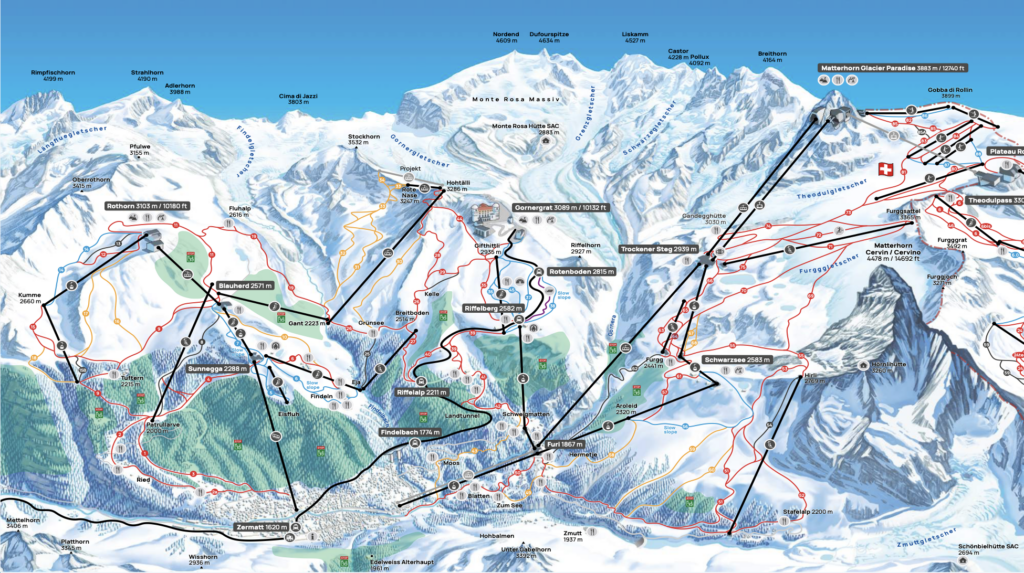
The easiest way to understand Zermatt’s ski area is to divide it into its main sectors.
Sunnegga is accessed directly from the village by funicular and is one of the most useful parts of the mountain for families and beginners.
Continue higher, and you will reach Rothorn, where the terrain becomes more challenging and the Matterhorn views become particularly impressive. You want to get your photos here.
The area is also known for its sunny aspect, making it a popular choice on clear days.
The Gornergrat combines skiing with the famous mountain railway that winds up to the Gornergrat viewpoint and museum.
The train starts in the centre of Zermatt so non-skiers or skiers alike can choose to ride from here or, if you’re on skis, there are various stops up the mountain where you can ski to and ride the train further up.
For non-skiers, it is also one of the best ways to experience the views and surrounding mountains. And for skiers, it’s an incredibly unique way of gaining some altitude – a bit different to the standard chairlift or gondola!
Matterhorn Glacier Express is one of the lifts from the centre of Zermatt that services the highest part of the ski area and the link towards the Italian side (Cervinia).
The altitude here is considerable, so conditions can be very different from those in the village. Often, this lift and the link to Italy close due to adverse weather and wind, so it’s worth keeping an eye on conditions on the day and throughout the week.
On a clear day, however, the views are exceptional, and the area (on the Swiss and Italian side) is an essential part of a week’s skiing in Zermatt.
Across the border in Italy, Cervinia and Valtournenche add around 160km of pistes to the wider ski area.
The Italian side adds another dimension altogether. Once across the border, the scenery and runs change pretty immediately, with fewer trees and long, broad, rolling runs. Although a lot of them are graded ‘red’ they’re generally much easier than this and easier than the Swiss side of the ski area.
It is worth dedicating at least one full day to exploring the Italian side if conditions are suitable and well worth it for the dining options too. It’s surprising how different it can feel!
| Ski Lift Type | Count |
|---|---|
| Gondolas & Cable Cars | 24 |
| Chairlifts | 19 |
| Drag Lifts | 11 |
| Mountain Train | 1 |
| Funicular | 1 |
Zermatt has several established ski schools offering private and group tuition for adults and children. For families, we generally recommend arranging children’s lessons before arrival, particularly during Christmas, New Year and February half term.
Private lessons can be especially useful for adults who have skied before but want to improve technically, or for families with children at very different levels.
In Zermatt especially, a private guide and instructor can help; even advanced skiers can make the most of the ski area. There’s even more value than normal in insider, local knowledge on where to ski and where to start your ski day from in Zermatt in comparison to other destinations.
There are numerous ski rental shops in Zermatt, offering skis, boots, snowboards and other equipment. We would typically recommend hiring equipment in Zermatt as it saves you having to travel by rail with it, and also, it means you can make use of the rental shop’s storage options, which are often near the lifts.
There’s a variety of ski pass options in Zermatt.
The standard Zermatt ski pass gives access to the Swiss side of the ski area. It’s then possible to get an international pass to the Matterhorn Glacier Paradise that allows you to ski across the Swiss-Italian border.
For a week-long holiday, the international pass can make sense for confident skiers who want to explore the full area.
However, especially in peak winter, the link is occasionally closed; it’s worth looking at the weather before committing to a full 7-day international pass or upgrading on the days you know you’ll be crossing.
For families with beginners or guests who are less interested in covering large distances, the Swiss area may be more than sufficient. It is also possible to get just a beginner ski pass focused on the Sunnegga area for young ones who won’t be travelling further afield.
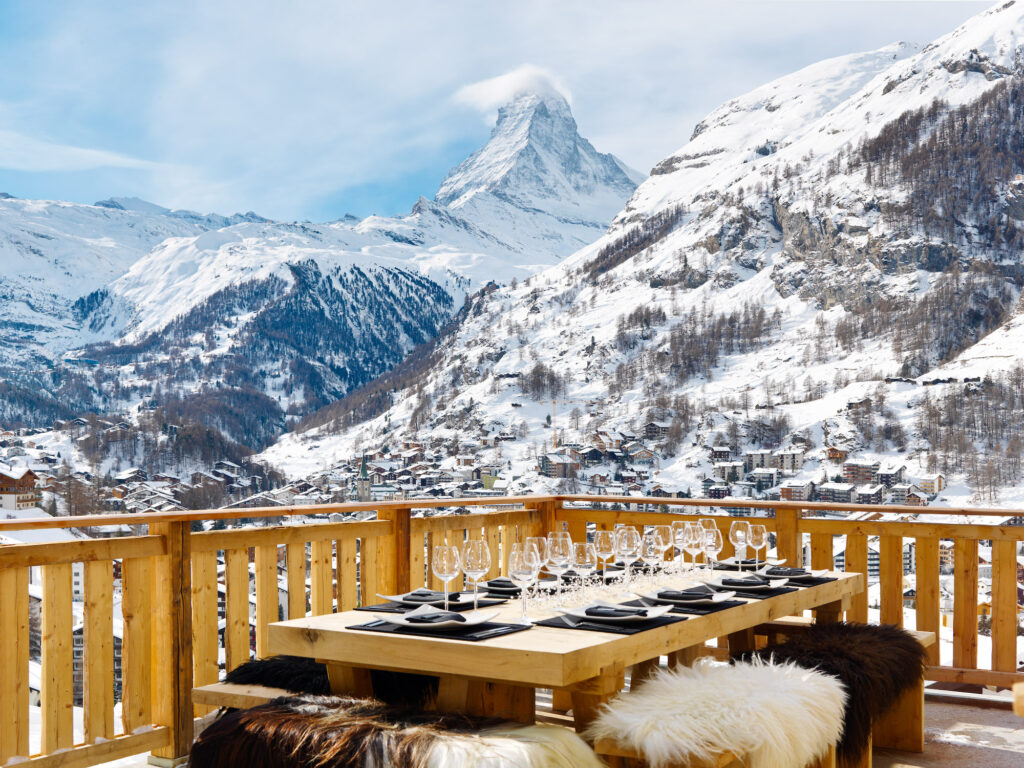
Despite its reputation as a destination for serious skiers, Zermatt is perfectly capable of catering for beginners.
Sunnegga is the main starting point, with dedicated learning areas and gentle terrain. The Wolli Adventure Park provides facilities specifically aimed at children learning to ski.
The advantage of arranging private lessons is that an instructor can introduce you to the mountain gradually and choose terrain appropriate to your confidence.
For intermediate skiers, there is an enormous amount to explore.
Blue and red pistes run across the main Swiss sectors, while the Italian side provides a change of scenery and some particularly enjoyable long, easier runs.
A highlight on the Cervinia side is the red ‘Reine Blanche’ run, which goes from the top of the Matterhorn Glacier Express (3,883m) down 22km to Valtournenche (1,524m). This is the longest marked red run in the world and is well worth completing.
The pistes in Cervinia are particularly well groomed and very wide, and this is no exception. It’s a lovely rolling red where intermediates, with some stamina, can really enjoy themselves and pick up confidence. A couple of properties like Chalet Snostorm and Heritage sit just off to the side of the end of this piste if you’re interested in a stay in Valtournenche.
The best approach is usually to explore one sector at a time rather than trying to cover the entire mountain in a single day.
Advanced skiers can take advantage of steeper pistes and more demanding terrain across the resort. Piste 16 (Chamois) is a great, steeper red at the top of Rothorn that leads all the way down into the wooded Furi area. As a result, there’s a great mix of scenery and skiing skills used to complete it as it progresses from an open bowl to a little funnel and ridges through the trees.
Zermatt has several itinerary runs (marked off-piste) which are avalanche controlled and safe, but, Zermatt’s pure off-piste terrain is one of its attractions for experienced skiers, with an appropriate guide of course
The wider region also has extensive opportunities for guided freeriding and ski touring around the glacier.
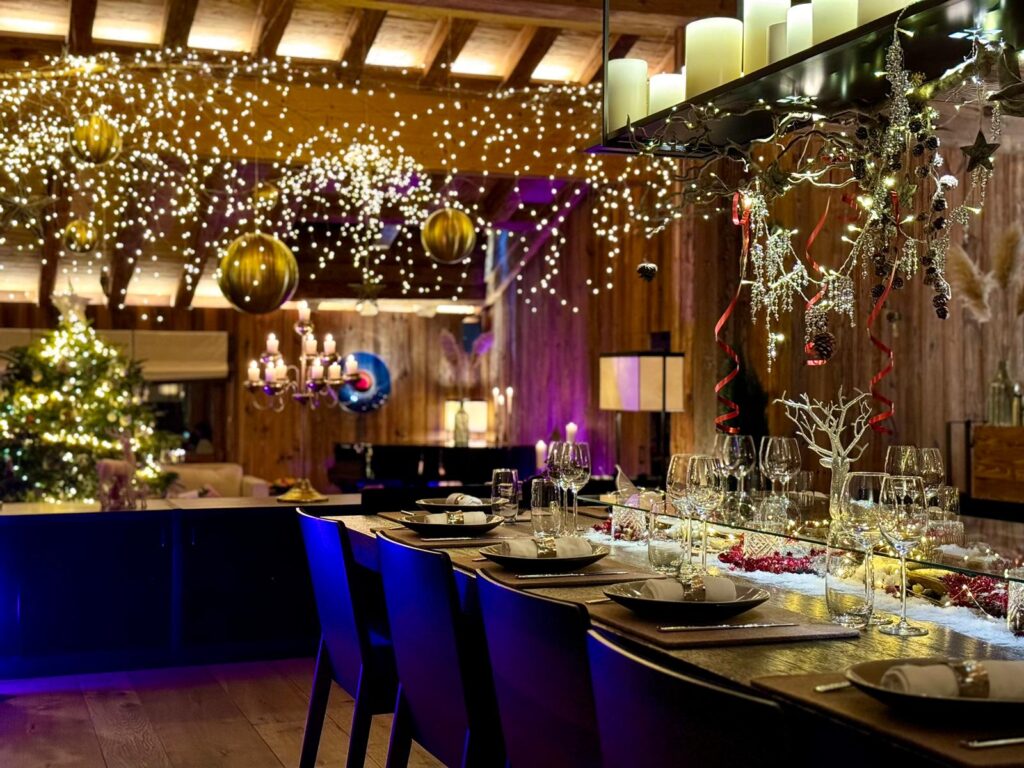
Zermatt is as much about what happens off the mountain as it is about the skiing.
Considering it’s a fairytale, cute town, Zermatt has a really lively après-ski and nightlife.
Coming off the mountain on either side of the ski area and village, there are two runs. The red ‘50’ piste on the Furi side is one of the liveliest home runs in Europe. It’s lined with four or five bars, and as you progress along, you go from sunshine deckchair spritzes to progressively loud music and dancing.
Down from Sunnegga on the other side of the ski area on the red ‘2a’ piste, you’ll come across a very civilised champagne bar with freshly popped bottles, caviar and maybe a saxophonist. It’s quite the contrast to the other side of the village. Further down from here, you reach the Hennu Stall bar, which is the wildest and most well-known of Zermatt’s après-ski bars.
There are lively bars throughout the village once you’re down too. Harry’s Ski Bar is a good choice for a relaxed, lively drink, while Snowboat is another popular option for après-ski and evening drinks. For something later and livelier, Papperla Pub is one of the village’s long-standing bars and stays open into the night.
Zermatt has a particularly strong restaurant scene, with over 100 restaurants. Fondue, raclette and rösti are obvious choices, but the village food scene goes considerably beyond traditional mountain food.
Findlerhof, above Sunnegga, is particularly well known as one of the best restaurants on the mountain, with great Matterhorn views. Nearby, Chez Vrony is another classic lunch spot when the weather is clear. Definitely worth visiting these on a clear, sunny day.
For a more traditional mountain-restaurant experience, Fluhalp is a good destination above the village, with impressive views across the surrounding peaks. Restaurant Zum See is another favourite, tucked into the woods; it’s particularly atmospheric when combined with a walk or ski down into the village.
For dinner in the village, there is everything from traditional Swiss cooking and fondue to more sophisticated international cuisine. Restaurant Spycher is a good option for traditional Swiss dishes, while L’Atelier Grandsire offers a more contemporary dining experience.
Zermatt’s pedestrianised centre has a good selection of shops, including ski and outdoor brands, Swiss watches and jewellery, clothing and local products. It is more sophisticated than the average Alpine village but retains enough traditional character to avoid feeling like a conventional luxury shopping destination.
Wellness is an important part of the luxury Zermatt experience. Many of the area’s higher-end hotels and chalets have saunas, steam rooms, hot tubs, pools or treatment rooms, while additional massage and beauty treatments can be arranged. Due to building regulations for them, they have to be open to external guests, so day passes are quite common even if staying in a luxury chalet or apartment separate from the hotel.
Of course, after a day skiing, coming home to a private spa can be particularly valuable; hence, a number of our properties have their own private wellness facilities too.
For guests wanting to keep active off the slopes, the Sport- und Freizeitarena in the centre of the village has an outdoor tennis court and beach volleyball and basketball facilities in summer, while winter brings outdoor ice skating, ice hockey and curling. There are also indoor climbing, tennis and fitness facilities for a poorer weather day or a change of pace.
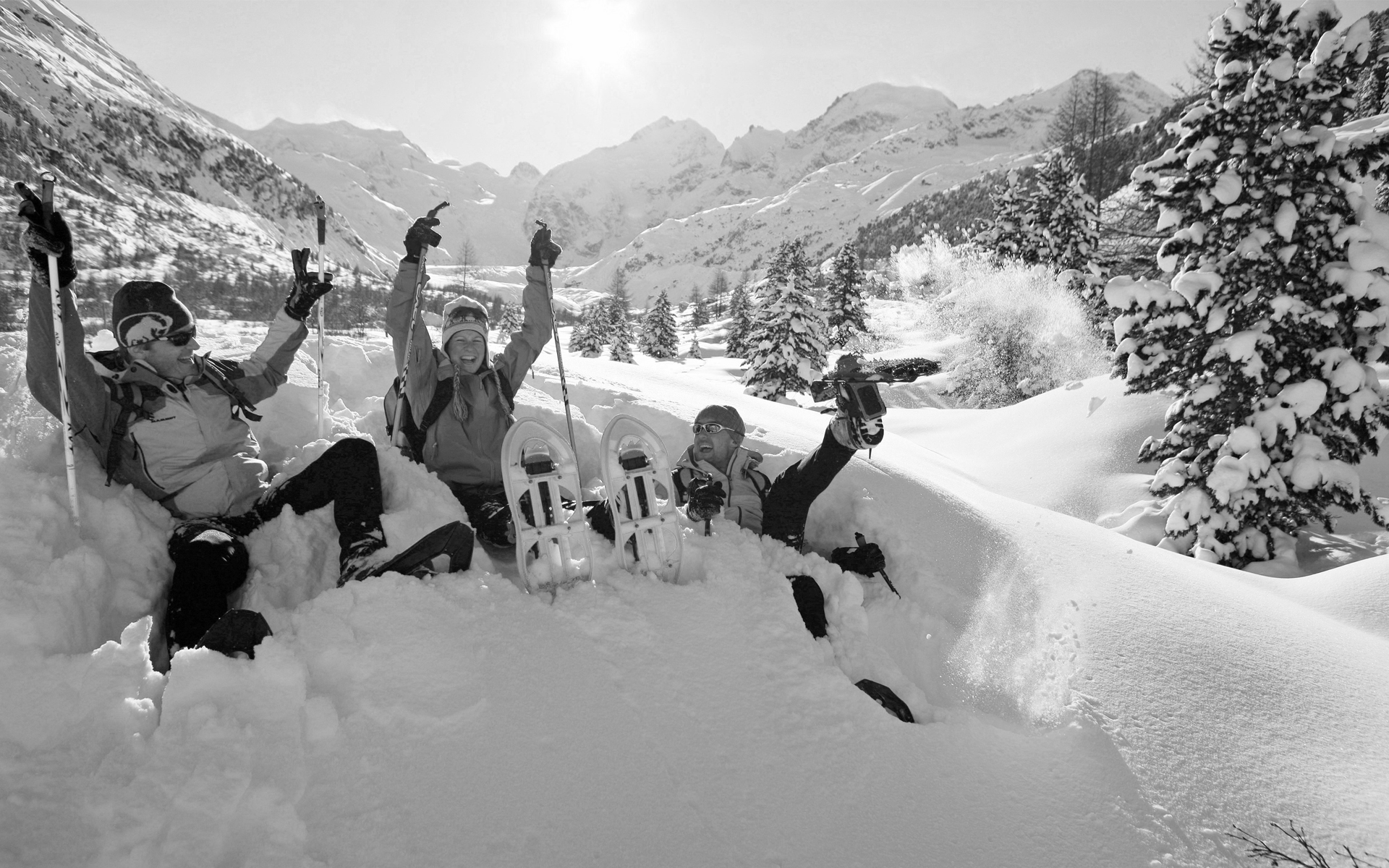
Zermatt is excellent for non-skiers who want to spend time in the mountains.
There are numerous marked winter walking routes and snowshoe trails, with the mountain railway or cable cars providing access to different starting points. These pedestrian-friendly lifts mean that non-skiers can still meet friends or family for lunch on the mountain rather than spending the entire day in the village.
Sledging is another good family activity. The route between Rotenboden and Riffelberg is one of the best-known sledging runs in Zermatt and can easily be incorporated into a day around Gornergrat. Going up the Gornergrat railway is worthwhile regardless of whether you’re sledging or not.
The train climbs from the village to Gornergrat, with panoramic views of the Matterhorn and surrounding 4,000m peaks. It works particularly well for non-skiers or as a half-day excursion.
For an even higher-altitude experience, take the lifts to Matterhorn Glacier Paradise (this is the top station of the Matterhorn Express Lift).
At almost 3,900m, it’s the highest mountain station in Europe that you can ski from (apart from Aiguille du Midi; however, this is more for advanced, guided off-piste). Up at the Matterhorn Glacier Paradise, there’s a viewing platform with extensive views across the Alps, a museum and an eatery too.
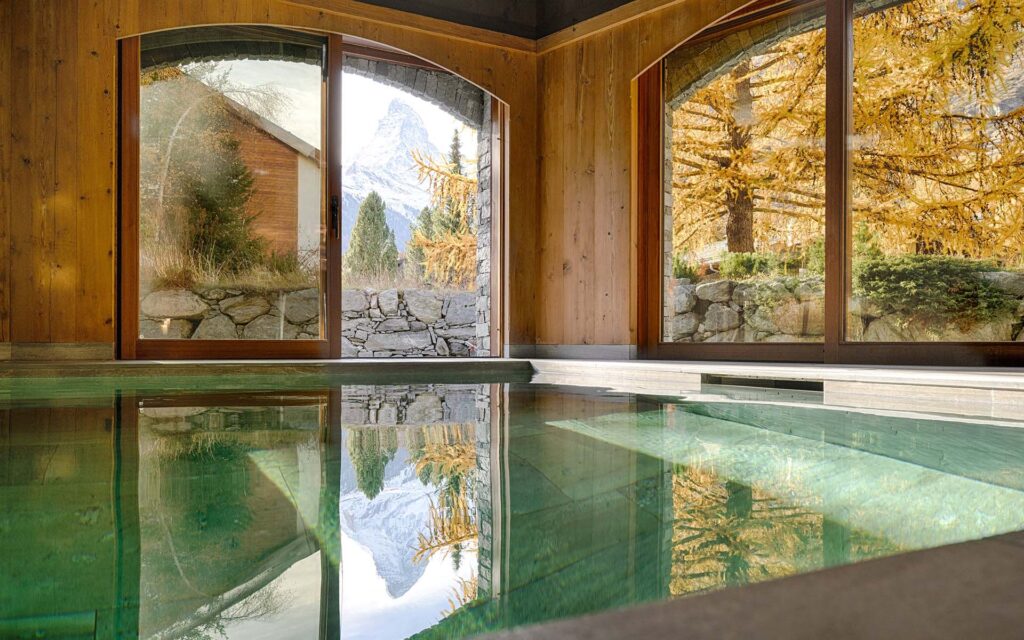
Zermatt is very much a year-round mountain destination.
In summer, the snow-covered landscape gives way to hiking trails, mountain biking routes, climbing and outdoor activities. The Matterhorn remains the centrepiece, but summer gives you a much better sense of the surrounding landscape, including alpine meadows, mountain lakes and traditional hamlets.
There are hundreds of kilometres of hiking trails around the destination, ranging from gentle walks to serious high-Alpine routes.
One of the classic summer excursions is the Five Lakes Walk, linking Stellisee, Grindjisee, Grünsee, Moosjisee and Leisee. The route gives several different perspectives of the Matterhorn and is particularly worthwhile on a clear morning. Stellisee is one of the best-known viewpoints for photographing the Matterhorn reflected in the lake.
Mountain biking is another major part of summer in Zermatt, with trails ranging from relatively gentle routes to challenging downhill terrain. E-bikes are a good option for guests who want to explore further without committing to a full day of strenuous riding. In fact, as the village is quite steep, a lot of locals get around on e-bikes too. You can, of course, rent them for the week to make journeying easier too.
For most visitors, however, the appeal of summer Zermatt lies in hiking, mountain biking and simply spending time in the mountains. However, Zermatt is one of the few Alpine destinations where skiing is possible in summer. Summer skiing is generally an early-morning activity, when the snow is at its best.
In Sion, in the valley bottom, roughly a 1-hour drive from Zermatt, is Alaïa Bay, which is continental Europe’s very first commercial outdoor surf lagoon. Spanning over 8,300 square meters at the foot of the Swiss Alps, it utilises world-class Wavegarden Cove technology to generate ocean-like waves every few seconds. So, feasibly you can be skiing in Zermatt and surfing nearby on the same day.
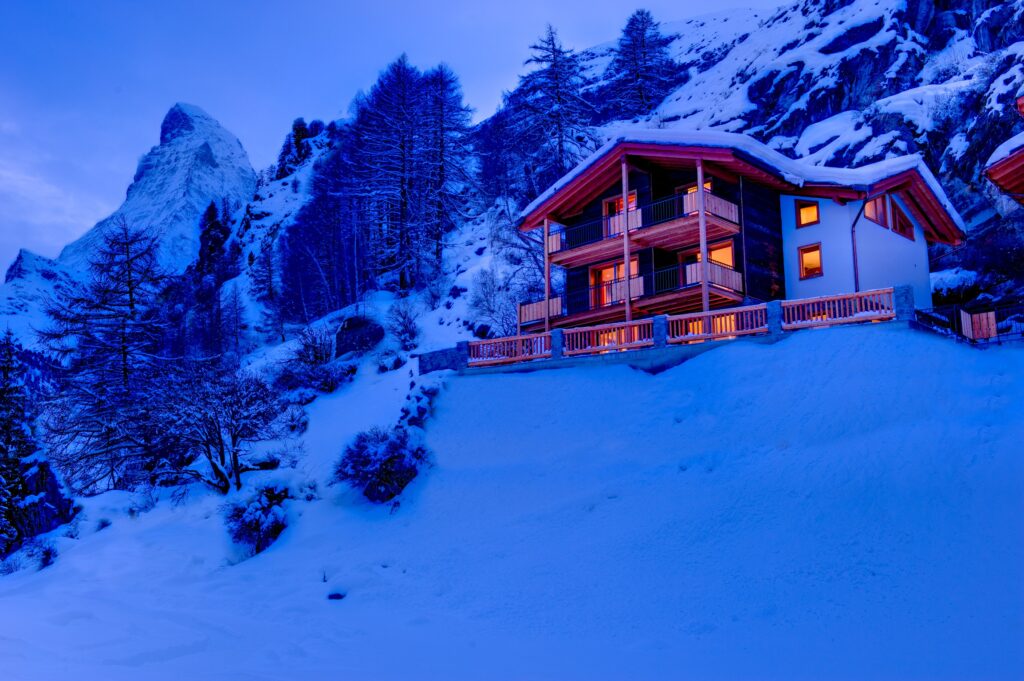
One of the most important practical things to know about Zermatt is that you cannot drive directly into the resort. The village is car-free. If travelling by road, you travel to Täsch, around 5km from Zermatt, where you leave your car and continue by train.
This sounds a bit more complicated than it is in practice! The shuttle train from Täsch to Zermatt takes around 12 minutes, and trains run regularly.
For many visitors, travelling by train is actually the simplest option off the bat from Geneva and Zurich airports. In general, Zermatt is particularly easy to reach by train from within Switzerland. Geneva and Zurich are the main airports for international visitors. Connections from Geneva, Zurich and other Swiss cities run towards Visp or Brig, from where the Matterhorn Gotthard Bahn continues to Zermatt.
The final journey is scenic in its own right, travelling up through the Matter Valley towards the resort.
Once you arrive, you won’t miss having a car. The village is compact and walkable, while electric buses and taxis provide connections when you need to travel further.
Zermatt is in the canton of Valais in southern Switzerland, close to the Italian border. It sits at the foot of the Matterhorn and forms part of the Matterhorn Ski Paradise with Cervinia and Valtournenche in Italy.
Zermatt combines high-altitude skiing, a large international ski area, a traditional car-free village, excellent restaurants and the Matterhorn itself. The skiing on the Cervinia side of the ski area is also very well respected.
A draw to visiting Zermatt is the fairytale village, fantastic restaurants and aesthetics, while still having a large, high-altitude ski area and great options on and off the piste.
The complete Matterhorn Ski Paradise has around 360km of pistes across Switzerland and Italy. The Swiss side accounts for approximately 200km.
Zermatt’s high altitude gives it an advantage, particularly later in the season, and the resort has access to glacier skiing. While no Alpine resort can guarantee particular snow conditions on specific dates probability of good and best snow conditions in Zermatt is incredibly high. Pretty regularly, they have the issue of too much snow!
Yes. Sunnegga has dedicated beginner facilities and Zermatt has several great ski schools. There are plenty of non-skiing activities if younger children need a break from the slopes.
Yes. Private cars are not permitted in the village. Drivers leave their cars in Täsch and continue by train or taxi. The village is pretty walkable, while electric buses, electric taxis, funiculars, cable cars and mountain railways connect the village with the surrounding mountain areas.
Usually not.
Genuine ski-in/ski-out accommodation is relatively rare in Zermatt. Some properties have very good ski access, but many guests will walk, use the electric bus or take an electric taxi to the lifts.
Very much so. Non-skiers can use the mountain railways to reach restaurants, viewpoints and attractions such as Matterhorn Glacier Paradise, while the village itself has excellent restaurants, shops, spas and other activities.
Zermatt sits firmly within the luxury end of the alpine market, particularly during Christmas, New Year
and school holidays. However, there is a wide range of accommodation and dining options.
For luxury chalet stays, prices vary significantly according to the size, location, facilities, catering and time of year; however, generally, there are better locations that offer higher quality and newer accommodation for the prices.
It really depends on what you want from the holiday!
December and New Year are popular for the festive atmosphere; February is particularly popular with families, while March and April offer longer days and excellent opportunities for high-altitude skiing and mountain lunches. Glacier skiing is available outside the main winter season, although the amount of terrain varies according to conditions.
The biggest differences are the car-free village, the integration of mountain railways into the ski infrastructure, the Swiss-Italian ski area and the relatively limited supply of true ski-in/ski-out chalets.
The overall experience is also less purpose-built. Zermatt feels like a historic mountain village that happens to contain one of the world’s major ski areas.
If you are ready to browse our luxury ski chalets, check out these related categories:
Browse our luxury ski chalets in Zermatt and feel free to contact us to discuss your next ski trip to Zermatt.
Luxury Ski Chalets in Cervinia
Luxury Chalet Rentals in Switzerland

Author
Growing up skiing in the Alps and spending summers sailing sparked a lifelong passion for travel and adventure. Turning a lifelong passion for travel into a career, specialising in luxury ski chalets and summer villas, I love sharing first-hand knowledge to better understand our destinations and shape your next escape.
5 October 2026
View author
Our expert advisers will curate a bespoke shortlist of the finest stays, tailored to your budget and preferences.
 The Best Ski Resorts for Spring Skiing
  Top 7 Apres-Ski Drinks & Recipes for Your Alpine Escape
  The Top 5 Closest Ski Resorts to Geneva Airport
  Geneva Luxury Holiday Guide
  Switzerland Luxury Summer Holidays Guide
  Marbella Luxury Holiday Guide
  Majorca Luxury Holiday Guide
  Ibiza Holiday Guide
  Spain Luxury Holiday Guide
  Algarve Luxury Holiday Guide
  Portugal Luxury Holiday Guide